A Conversation That Never Happened: FRANTIŠEK DRTIKOL and C.G. JUNG on Light, Shadow, and the Path to the Self
Miroslav Dostál
Dialogue
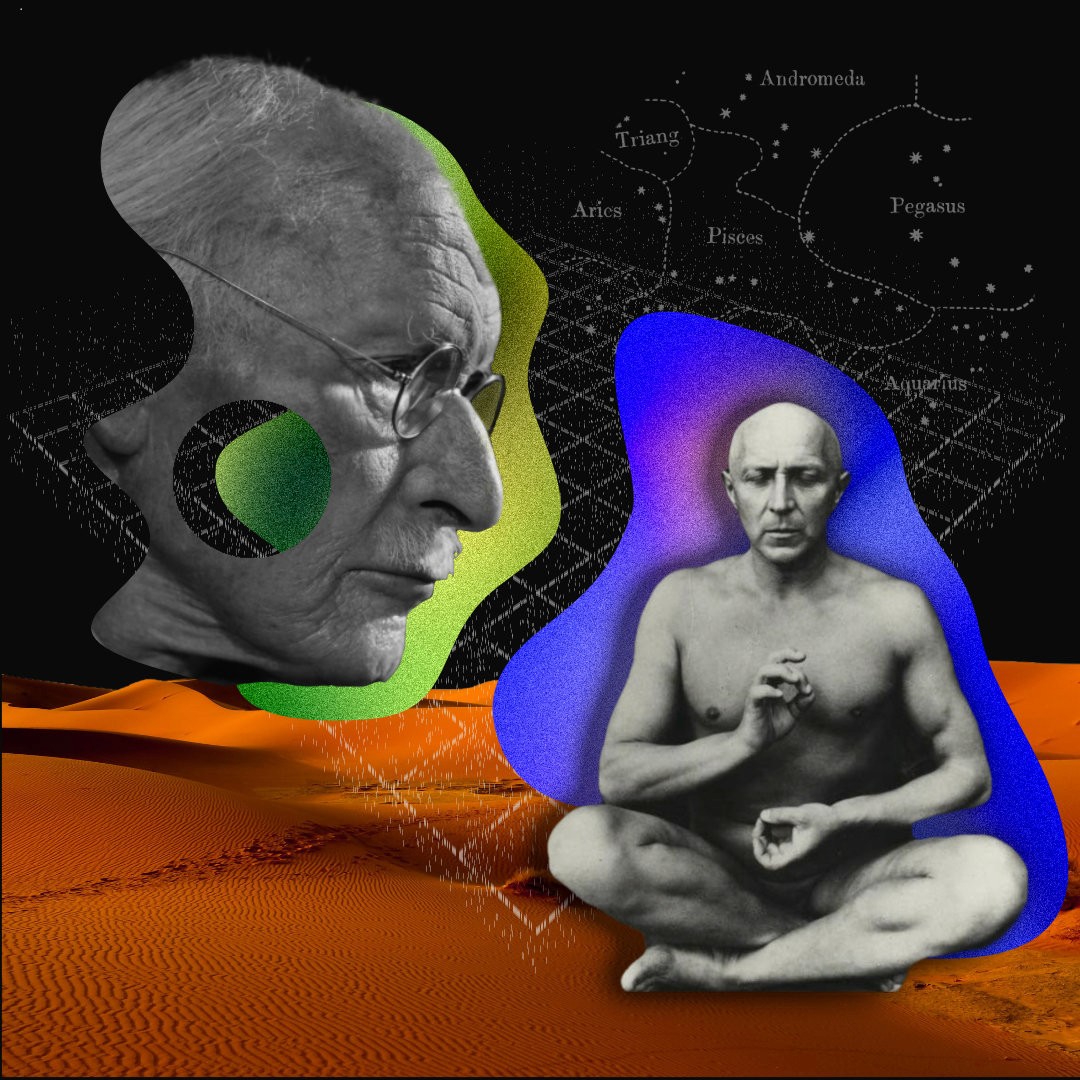
JUNG is examining the images and paintings that DRTIKOL shows him.
JUNG: Your photographs fascinate me, MASTER. Light and shadow in perfect balance. As if the body were only a symbol of something deeper.
DRTIKOL: The body is a symbol, DOCTOR. When I photograph the nude body, I’m not photographing flesh. I’m photographing energy, the flow of life that the Western eye doesn’t see.
JUNG: An archetypal image. Your women are not particular individuals — they are emanations of the collective unconscious. The ANIMA — the inner feminine principle that every man carries within. I first recognized it in 1913 when I nearly collapsed. I saw her — in visions, in dreams. It nearly cost me my mind.
DRTIKOL nods.
DRTIKOL: I know it. I’ve walked through darkness too. In meditation I saw things a person would rather not see. Demons. Fear. The emptiness beneath everything.
JUNG: Nekyia — the descent into the underworld. A necessary step of individuation. Without it, a person remains on the surface. I recorded it in the Red Book — but never published it. It was too… personal. Too close to the edge.
DRTIKOL: And I closed my studio. Sold everything. Left for Spořilov. Also too personal. Also on the edge.
A silence. Both know what it means — to risk everything.
JUNG: The SHADOW — what we repress. In your photographs I see how you work with it. Light cannot exist without Shadow.
DRTIKOL: Exactly. But you say — integrate the Shadow into the Light. And I say — stop believing that Light is good and Shadow is bad. Both are illusions. Reality is what lies behind them.
JUNG: Behind them is the SELF — the wholeness that contains the opposites. But you cannot reach the Self through meditation alone. You need the EGO — a structure capable of containing that wholeness. I’ve seen people lost in mysticism. Psychosis. Inflation. Fragmentation.
DRTIKOL: And I’ve seen people lost in the Ego. Endless analysis. Talking about the Self instead of experiencing it. Theory as an escape from practice.
JUNG: That is a fair critique. But the difference is this: I walked through that darkness — and then I gave it form. Archetypes, the Self, individuation — these aren’t just theories. They are maps for those who come after me.
DRTIKOL: And I walked through — and left form behind. Buddha said: My finger points to the moon. Do not look at the finger. You have created a whole system of fingers — and now people study the fingers instead of the moon.
JUNG smiles.
JUNG: Maybe you are right. Maybe I created a new dogma. But the West needs dogma — a structure that one can enter. You cannot tell a European neurotic: “Sit and be silent.” He will collapse.
DRTIKOL: And you cannot tell a meditator: “Analyze your archetypes.” That kills the experience. Each path has its place.
JUNG: Perhaps. I chose the path through form — psychology as a bridge between science and mysticism. You chose the path outside of form — direct realization.
DRTIKOL: And both are valid. You teach people how to prepare for the encounter with the Self. I teach how to receive it when it comes.
Another silence. A candle flickers.
JUNG: I wrote a commentary on the Tibetan Book of the Dead. I warned: the West cannot simply import Eastern thought. We have a different psychic structure.
DRTIKOL: I’ve read your commentary. And you are right — you cannot just import it. But you also cannot remain only in Western psychology. One must pass through. I went through Buddhist practice — yet I stayed a Czech from Spořilov. I speak things “straight out.” That is my West.
JUNG: And I went through mystical visions — yet I remained a Swiss doctor. I need categories, structure. That is my West.
DRTIKOL: So we’re both on the bridge. Just standing at opposite ends.
JUNG: Perhaps. Or we’re standing in the same place — just looking in different directions.
They both smile.
JUNG: What do you say to your students when they come with neurosis?
DRTIKOL: Nothing. We sit. We are silent. And when their Ego begins to speak — fear, desire, stories — sometimes I say: “Fuck it. Stop making new crap in your head.”
JUNG: (laughing) That’s Zen. A direct blow to the mind.
DRTIKOL: And what do you say?
JUNG: I listen. I look for patterns. Archetypes in their dreams. The Shadow in their projections. And then I show them a mirror — this is your mother. This is your father. This is your shadow. Only when they see it — can they integrate it.
DRTIKOL: Two ways. One cuts through form. The other works with form. Both are valid.
JUNG: But I fear — if a person has not walked through the darkness that you and I walked… they are in danger. Mysticism without integration becomes psychosis. Psychology without transcendence is sterile.
DRTIKOL: I agree. That’s why I tell my students: first you must know yourself. Know your anger, fear, lust. Only then can you go beyond. Without that, it’s just escape.
JUNG: That is exactly what I say. Without confronting the Shadow, the Self remains just fantasy.
They both nod.
JUNG: Master, do you think we are truly that different?
DRTIKOL: No. We both walked through darkness. We both survived it. You turned it into a map. I turned it into silence.
JUNG: And we both know — it cannot be bypassed. It cannot be intellectualized. It cannot be spiritualized. It must be walked through.
DRTIKOL: And only then — on the other side — is the light. Not as an escape from Shadow. But as its acceptance.
JUNG: Coniunctio. The union of opposites.
DRTIKOL: Nirvana and samsara are the same.
They both smile.
JUNG: Have you found it, MASTER?
DRTIKOL: If I say yes, it’s a lie. If I say no, it’s also a lie.
JUNG: I would say: I am on the path. And it never ends.
DRTIKOL: Maybe that is the same thing, DOCTOR.
Miroslav Dostál