Angine de Poitrine - Initiation
Ivo Češek
Article

◉
Before stereo cosmology
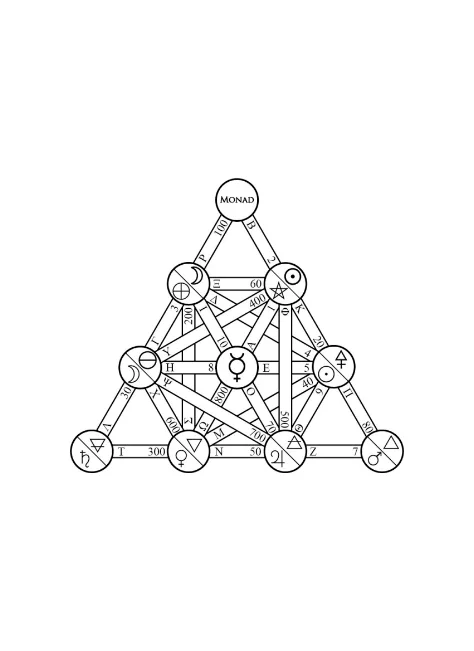
The Monad is undividedness. Unity, the original substance, the highest being. It is the state from which we all arise, to which we all return, and in which we always already are. In it, one may glimpse the non-egoic nature of everything and everyone. It is silent, indivisible, without relation.
Then the Dyad emerges. The first division of unity. The arising of difference. Separation, subjectivity, polarity. The material world becomes perceptible. Distinctions appear. It allows for relation, and with it, the first harmony. Can anything be known without difference? Can anything exist without relation? It gives rise to both tension and harmony.
The Triad brings balance, stability, harmony. A stable structure. The foundation of the chord. Thesis, antithesis, synthesis. Brahma, Vishnu, Shiva. Father, Son, Holy Spirit. The Japanese san — three — sufficiency.
The Tetrad brings structure, form, manifestation. The emergence of the world as we perceive it. Space, order, stability. What was relational becomes tangible. The foundation of reality. Four directions, four elements. The point becomes a world. Unity unfolds into form.

◉ ◉
The dawn of reality - Tetractys
Music intervals ➢ structure of universe
Musical intervals are defined as ratios between two frequencies. Each tone is, physically, a periodic vibration. If we take a string of length 1 as a reference tone, for example A = 440 Hz, and shorten the string by half, the resulting frequency doubles to 880 Hz — producing an octave. Similarly, other simple ratios of string length, such as 2:3 or 3:4, give rise to further harmonic intervals (the fifth and the fourth), demonstrating that musical harmony is directly grounded in mathematical relationships.
Human perception of pitch works logarithmically: an octave (2:1) is not just a physical ratio, but also a psychological unit. The ear therefore “thinks in ratios,” not in absolute values.
"The highest goal of music is to connect one's soul to their Divine Nature, not entertainment" ~ Pythagoras
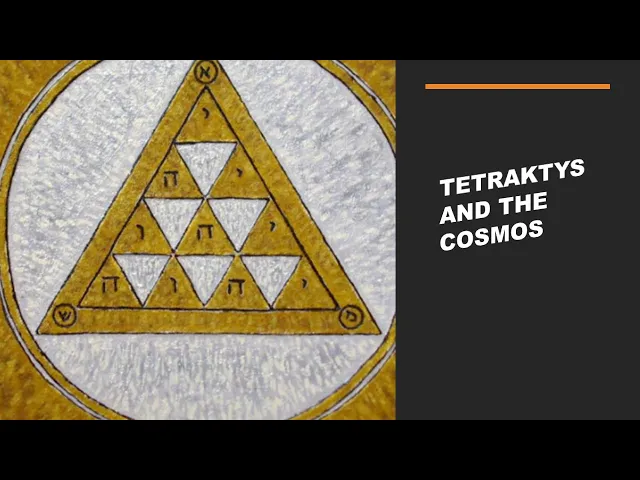
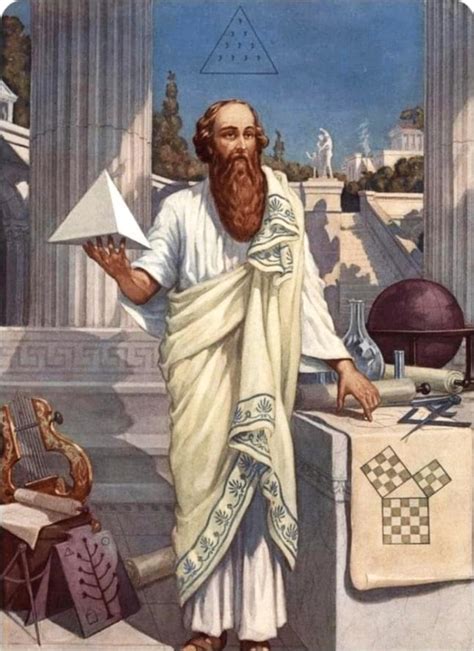
The Pythagoreans understood that numbers are not mere abstractions, but have form in space. For them, number was not a tool of measurement, but the very principle of reality — a way in which order reveals itself. Pythagoras himself is said to have recognized harmony not only in sound, but in the structure of the cosmos, suggesting that the same ratios governing musical intervals also underlie the movement of the heavens. The Tetractys stands as one of the earliest models of reality in the history of mathematics.

A similar structural intuition appears in Jewish mysticism. In Kabbalah, the Tree of Life presents a diagram of ten sefirot — emanations through which the infinite becomes manifest. While not identical in form, it resonates with the Pythagorean tetractys: both describe a movement from unity into multiplicity, structured through number.
"Each celestial body, in fact each and every atom, produces a particular sound on account of its movement, its rhythm or vibration. All these sounds and vibrations form a universal harmony in which each element, while having it’s own function and character, contributes to the whole." ~ Pythagoras
The tetractys unfolds as 1 + 2 + 3 + 4 = 10, a numerical expansion of the One into an ordered whole. Likewise, the sefirot are understood as stages or qualities through which the hidden source expresses itself in the world. What appears in both is not a shared origin, but a shared insight — that reality is not chaotic, but structured, and that number can serve as a bridge between the invisible and the manifest.
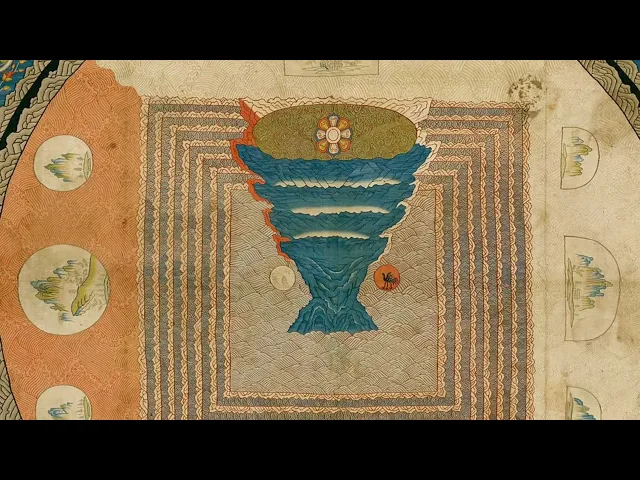
Another intuition appears in Indian cosmology in the concept of Mount Meru, the symbolic center of the universe. From this central axis, reality is described as unfolding into multiple layers and realms. While its form differs from the tetractys, the underlying idea remains strikingly close: a movement from unity into structured multiplicity. What is expressed geometrically in the tetractys appears here as a cosmic mountain — a vertical unfolding of the same principle.
◉ ◉ ◉
See the music
Examples of orbital resonances:
Jupiter’s moons — Io, Europa, and Ganymede — are bound in an exact 1:2:4 resonance. Io circles Jupiter four times, Europa twice, and Ganymede once.
Pluto and Neptune are held in a 3:2 resonance. Resonant relationships of 2:1 can also be found among Saturn’s moons.
Here, harmony appears not as a fixed sound, but as recurring proportion in time. The Solar System is not arranged like a chord, but like a rhythm.
"The stars in the heavens sing a music, if only we had ears to hear" ~ Pythagoras
The brain does not produce harmony through fixed ratios, but through the dynamic alignment of rhythms in time. One reason why 120 BPM feels so natural lies in its simple divisibility by two, creating a stable and easily structured groove. This allows the rhythm to unfold into clear layers and subdivisions. The brain does not consciously calculate these ratios, but it readily synchronizes with them. As a result, bodily processes such as walking, movement, and even aspects of internal rhythm can align with the beat. Ratios rarely appear as exact numbers in nature, but as attractors — patterns toward which systems naturally organize.
Pulse gives rise to time. Division introduces relation. Groove emerges as repetition becomes felt. Structure appears when these layers align into a coherent whole. In this way, rhythm unfolds from unity into form — from a single beat into an ordered system.
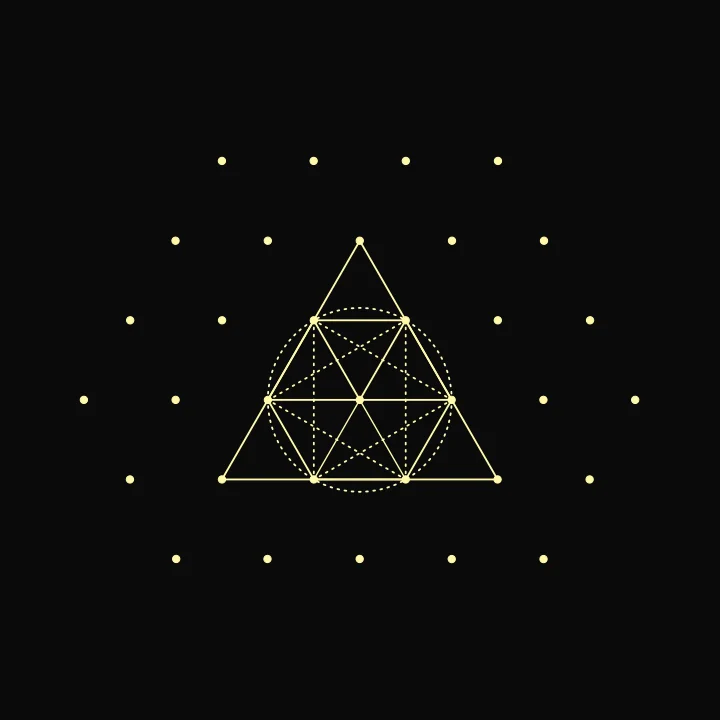
Pro tip: You don't need Sacred geometry right away. In altered state of consciousness, try taking a look at the simple line or the crossed line. If you remain calm, you can see a great deal even in this simple geometry.
◉ ◉ ◉ ◉
Are they Pythagoreans?
And finally.
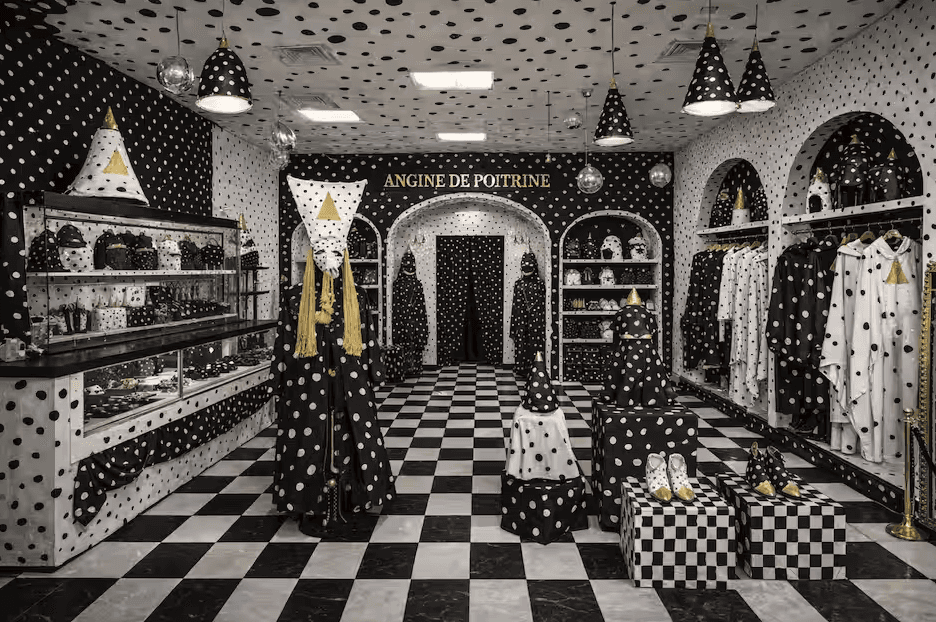
What does all of this have to do with the band Angine de Poitrine (angina pectoris)? Perhaps nothing at all. But I would be surprised. In their dadaistic mysticism, the triangle, pyramid, and the diagonal dotted grid dominate. The pyramid is gold — with golden hair and dollar-sign eyes. What appears as symbolism is not merely visual, but a reflection of underlying relationships — the same ones that emerge through their music. If they are just people, they spent years learning their instruments and, through music, discovered these relationships that surround us and shape our experience of reality. And once a person understands them, they can begin to use them in their own way.
"Respect yourself... The rest will follow." ~ Pythagoras
So instead of the usual twenty or so frets on a guitar, I counted over 35 on Khn's instruments. Yes, this is math rock, as my guitar teacher Rick Beato said. Quite literally, this is what he had been waiting for. And it seems he is not alone. Their KEXP performance became a viral hit, reaching 3.5 million views within a month. The fourth 2026 pressing of their vinyl, Vol. I, now sells for a beautiful $500 and the first pressing started now at €1290 . I almost hesitate to mention that Vol. II is coming out in early April — its initial pre-release batch already sold out, just as all their concerts will likely be for several seasons to come.

Microtones, by the way, are fundamental to Indian music, which often makes use of any audible difference between pitches. The Indian sitar has adjustable frets (Thanks to Zapa and his wife for the Ravi Shankar album received years ago, did you remember the crazy party?), and the instrument is built so that strings can be bent significantly sideways, producing the characteristic psychedelic pitch bending. In synthesizers, we can also tune individual oscillators or filters, and even modulate that tuning over time, creating captivating super-resonances into which I have immersed myself for entire days. A violinist works within this continuum naturally, since there are no frets at all — moving freely between tones, sometimes almost appearing as a different kind of human being.
Math rock also employs experimental rhythm. In Angine’s case, this can be heard for example in the first part of the track Fabienk, where two rhythmic structures collide in such a way that, for a moment, you genuinely lose your footing while trying to follow the groove — as if a step were missing, or suddenly one too many appeared. It is almost unbelievable that someone can perform this live, loop it precisely with power drums, and then layer additional melodies on top, . The second part of Fabienk, on the other hand, I had looped at home for days — very loud — and once again, it subtly shifted my perception of the world.

This is how you run a brilliant alternative music business. Yes, this is truly something we have been waiting for. I feel it. A new era is always arriving. Absence of light will yield to light and gradually leave this world, as has long been foretold. Perhaps Pythagoras already knew this. Quite possibly. Some have always known, some are beginning to feel it, others are starting to see it. From the perspective of time, for many, Angine represents the future. They do not need to reveal their physical form, perhaps because they sense that inwardly we are one. They do not need to speak in human language, because words are often far less than the mathematically precise relationships of tones through which one can travel across galaxies.
"To cognize the Divine Essence - this is the highest purpose of soul, sent by the Creator to the Earth!" ~ Pythagoras
Right now, people are eagerly trying to find out who they are. There is a growing stir around it. And perhaps what they are searching for is already looking back at them. What they will find is not something separate. It is themselves — it is you. We will all meet in the Monad.
Let us then enter this present frequency of transcendence that is already here. Do not remain in the absence of light. Angine de Poitrine will show you one of the infinitely many paths. And even if none of that were true, it's still a ton of fun.
The Second Renaissance is here and now. Thank You, Angine.