Christian d'Or
Ivo Češek
Setting


I’ve just read that the waking state is merely the second dream-pole of consciousness. It is becoming increasingly clear that we can be wherever we wish, whenever we wish. So why not the Arizona countryside? Or Verona. Isn’t it the fifteenth century? Perhaps it is — in certain fortunate pockets of smaller towns, sometime around one in the morning, it can still be impossible to tell whether we haven’t just wandered straight into the Renaissance.
And yet, on the corner of a small square with a fountain, there stands a Citroën DS 21. Its horn playfully sounds a tone no modern car is capable of producing anymore…
A woman steps out, wearing a mini dress. Of course, this is not about the fact that we don’t know her — quite the opposite. Seeing her, I briefly consider swapping my suit for a linen jacket and loafers. She is accompanied by a man in glossy patent-leather shoes. No doubt they are heading to a nearby dance wine bar with a beautiful terrace overlooking the sea.
Sometimes, when the mind is overloaded and one needs to step away from the main room, all that remains is an echo — blending with the crowd’s roar and other incidental noises, perhaps from the toilets or the bar. A hypnotised ear can no longer tell whether this murmur belongs to the rhythm of the set, or whether it is simply delay — whether it’s part of the DJ mix at all.

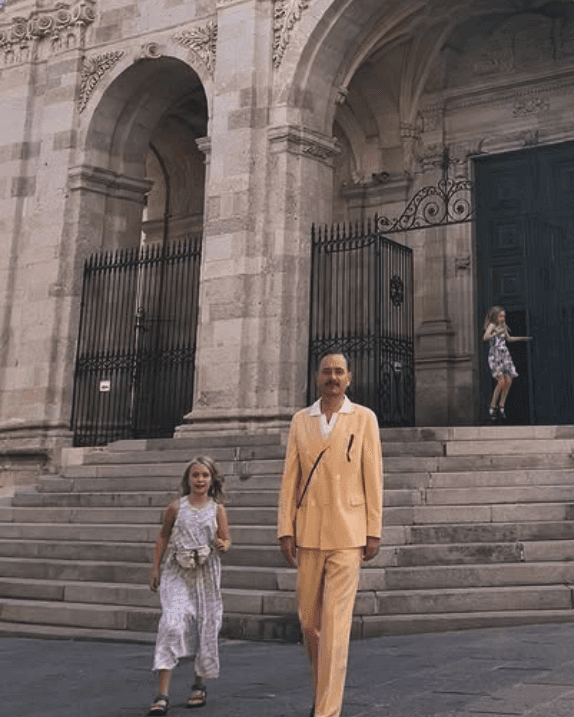
This is also how it can sound when a DJ allows two worlds to overlap for an extended moment — worlds never meant to be merged. Usually, this ends in an unintended and rather unpleasant disharmony. But unexpectedly, this is not the case here. Christian d’Or gives rise to allegorical states that could never be born in a mathematically correct musical universe. One might briefly experience something similar when listening on AirPods without noise cancellation, as the city’s random hiss intrudes into the music — but here, the cacophony is handled with remarkable sophistication. And so we may find ourselves both on Dagobah and in an Indian ashram. If entry into the Kingdom were paid with unguarded creativity, Christian would have his passage secured.
But back to that unfortunate love affair on the French Riviera in the 1960s. How do stories like these usually end? Or perhaps we should move instead to a Californian club, where someone like Frank Sinatra is performing — though certainly not Sinatra himself; that would be far too obvious. The only thing I know for sure is that the seating booths are upholstered in leather and gently tiered so that everyone can see the stage. Each table holds a small lamp with warm, soft light — long before the invention of LED technology. Most of the audience is smoking, and some of the women are wearing dresses adorned with shimmering sequins.
For any DJ, playing with nostalgia is no easy task — most aren’t even aware they’re doing it. What do you replace it with? And how often can you return to it? How do you avoid drowning in memories of first loves or your grandmother? Pathos has powerful tentacles. Yet when it works — when the storyteller guides you out of a space that is cosy and safe, but once the fire burns out becomes dark, cold, and damp — the experience can be profound. Hope must arrive in time. The line is razor-thin, believe me.
I am speaking in particular about the attached Studio 1111 Berlin playlist, which SoundCloud recommended to me based on the search term “ambient.” I have no doubt, however, that this represents only one side of his work, and I look forward to returning to the others in the coming days.
Is it Rotared? Absolutely. Christian d’Or of Denmark - Haute couture of DJing.